
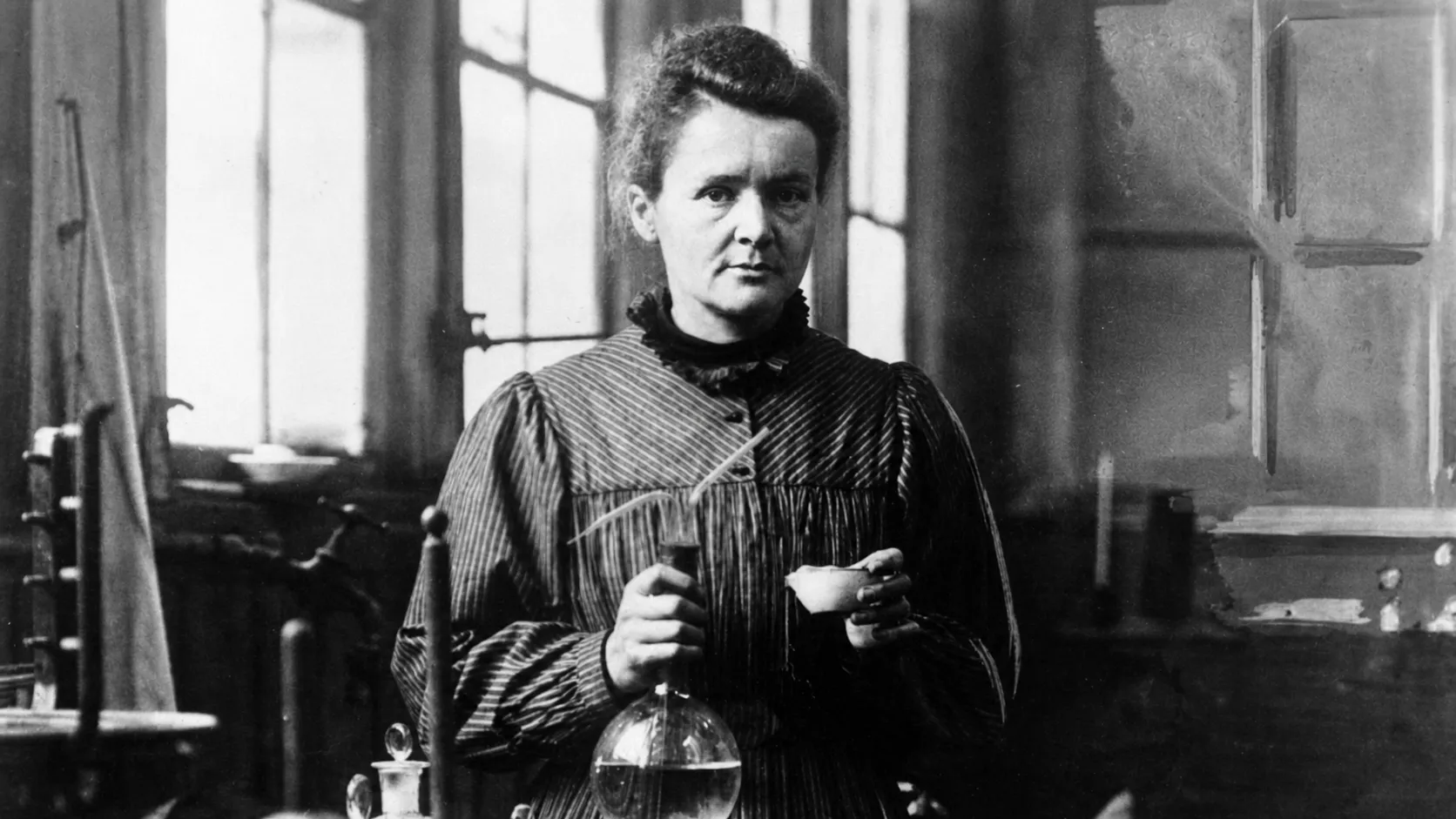
The Blue Glow in the Warehouse on Rue Lhomond
In the Parisian nights of the late 1890s, an old, abandoned dissection hangar in École Municipale de Physique et de Chimie IndustriellesOn Rue Lhomond, it housed one of the most extraordinary experiments in the history of natural sciences. The environment was anything but healthy: lacking adequate thermal insulation, with a dirt floor and a leaky glass roof that turned winter into a frigid ordeal and summer into a suffocating greenhouse, the space accumulated tons of pitchblende slag (pitchblende) imported from the mines of Joachimsthal, in Bohemia.
There, stirring steaming iron cauldrons with heavy metal bars under suffocating fumes of sulfide and chloride, Marya Salomea Skłodowska and her husband, Pierre CurieThey challenged the conceptual inertia of the 19th century. In the darkness of that makeshift shed, small glass ampoules containing concentrated precipitates emitted a bluish, ghostly phosphorescence. That continuous luminescence, generated without the prior absorption of photons or any external thermal or electrical stimulus, was not a mere artifice of classical chemistry: it was the visual signature of... matter in the process of spontaneous transmutation, announcing the downfall of the indivisible atom theory.
One of our joys was entering our workroom at night; then we would notice, everywhere, the luminous silhouettes of the bottles and tubes that contained our products. It was truly a delightful and ever-new sight for us. The glowing tubes looked like little fairy lights suspended in the darkness.
The Flying University and the Forge of Clandestine Knowledge
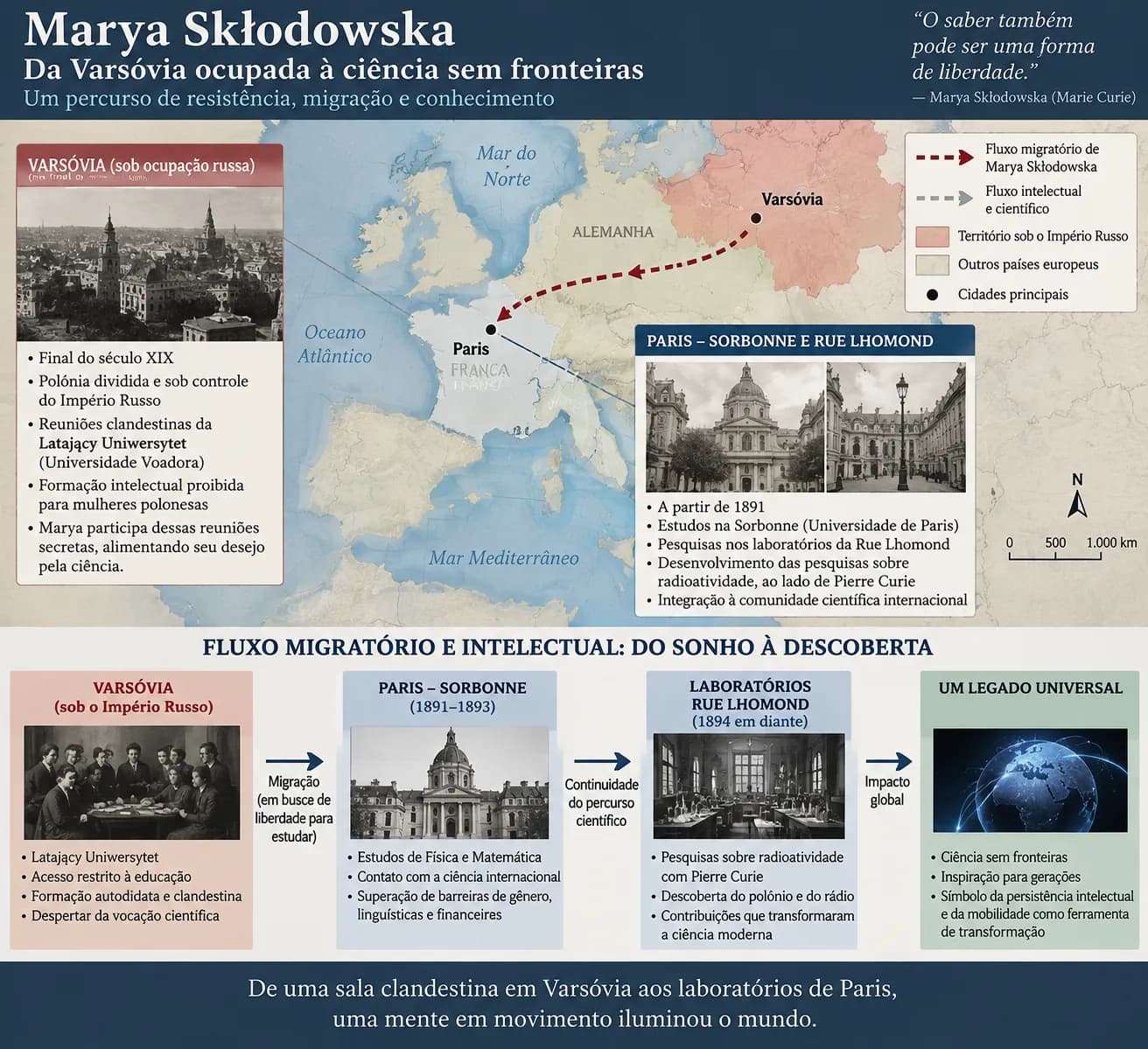
The genesis of Marie Curie's intellectual tenacity cannot be separated from the geopolitical context of 19th-century Poland. Subjugated by the Russian partition after the collapse of national uprisings, Warsaw faced an aggressive process of forced Russification, which prohibited the teaching of the local language and history and completely barred women from entering higher education.
It was in this context of imperial repression that Marya and her sister Bronisława joined the Latający Uniwersytet (the legendary Flying University), a clandestine, itinerant network of Polish intellectuals who taught advanced courses in physics, biology, history, and philosophy in alternating attics and basements to evade the Tsarist secret police.
To make Bronisława's medical degree in Paris possible, Marya made a pact of sacrifice: she worked for years as a tutor in rural Poland, financing her sister's studies while dedicating her nights to a rigorous self-taught program of differential calculus, analytical chemistry, and mechanics. In 1891, at the age of twenty-four, she arrived at the Gare du Nord with meager financial resources, but with an unwavering methodological determination to enroll in the Faculty of Sciences at the Sorbonne.
The Metrological Turn: The Piezoelectric Quartz Electroscope
In 1896, Henri Becquerel accidentally discovered that uranium salts impressed photographic plates protected from sunlight, attributing the phenomenon to an exotic form of "hypermetallic phosphorescence." However, Becquerel's research quickly lost momentum due to the purely qualitative nature of his optical observations.
The definitive epistemological turning point occurred when Marie Curie chose these mysterious rays as the subject of her doctoral thesis in 1897. Understanding that photographic methods were imprecise and subject to distortions, Marie designed a metrological framework based on... piezoelectric effect, discovered in 1880 by Pierre and Jacques Curie.
Using an ionization chamber connected to an electrometer and balanced with a piezoelectric quartz slide calibrated with micrometer precision, Marie measured the infinitesimal electric current generated when radiation ionized the surrounding atmospheric air. This methodological leap made it possible to convert a nebulous optical mystery into a measurable and reproducible electrostatic quantity.
The Breakdown of Atomic Dogma: Radioactivity and New Elements
By systematically quantifying all known minerals in the periodic table, Marie arrived at an iconoclastic conclusion: the intensity of the rays was completely independent of the element's chemical composition, temperature, light incidence, or mechanical pressure. The emission depended exclusively on... mass of uranium or thorium present in the sample.
Based on this inference, Marie formulated the hypothesis that would shake the foundations of deterministic chemistry: the emission of energy was a intrinsic atomic property...and not the result of molecular interactions. To describe this elementary physical dynamic, she coined the term... radioactivity (radioactivity).
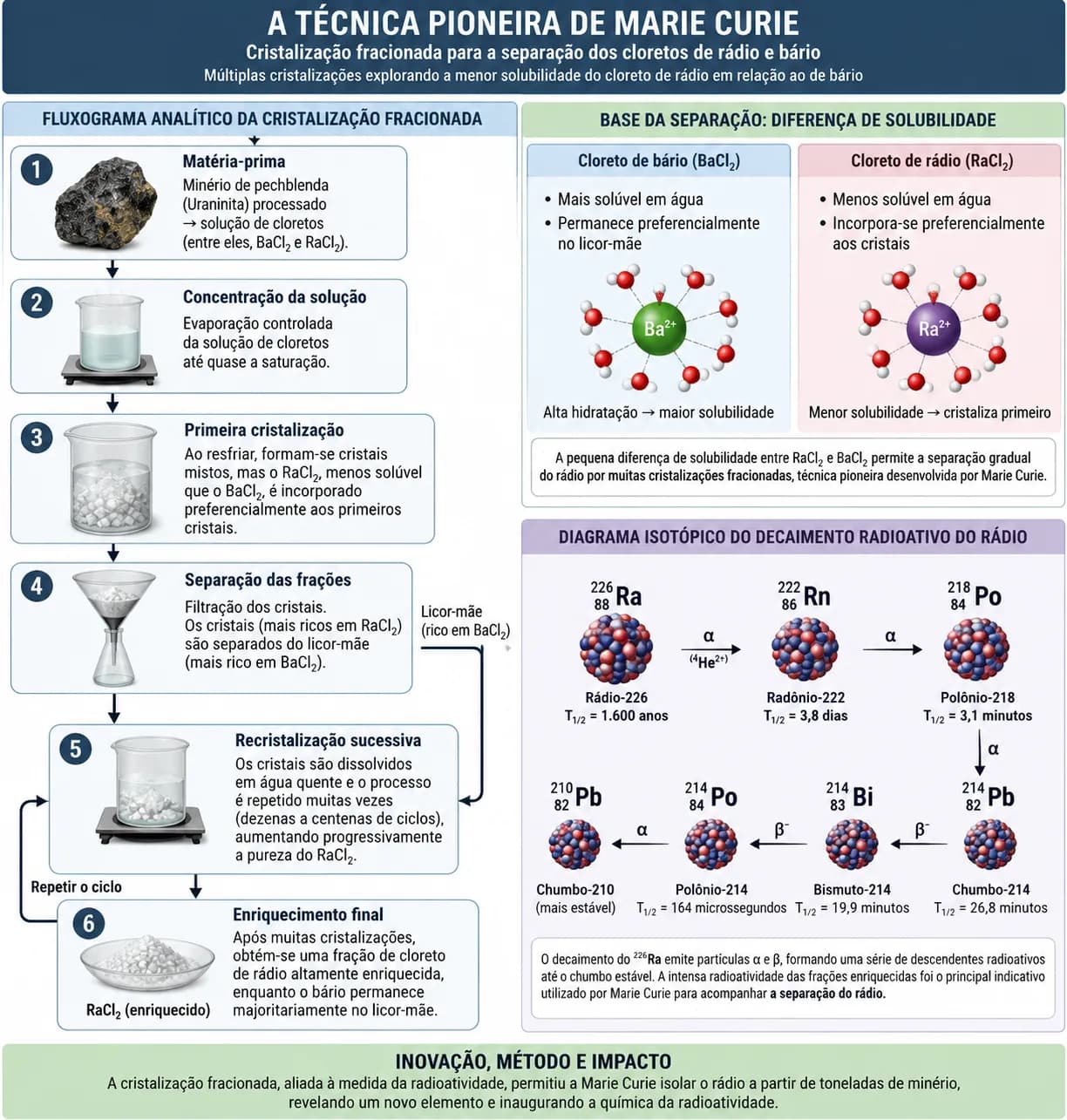
Even more disconcerting was the discovery that certain raw ores, such as pitchblende and chalcolite, exhibited ionizing activity four to five times greater than that of pure uranium. This implied the necessary presence of unknown elements in trace concentrations. In July 1898, the couple announced the polonium — baptized in open political defiance of Russian oppression that was erasing Poland from European maps — and, in December of the same year, the radio, a titan of nuclear emissions whose concentration in pitchblende did not exceed infinitesimal fractions of a milligram per ton.
Double Dedication and the Ethics of Open Science
International recognition was accompanied by intense institutional friction. In 1903, the Royal Swedish Academy of Sciences decided to award the Nobel Prize in Physics only to Henri Becquerel and Pierre Curie. Only after Pierre's uncompromising written intervention—formally refusing to accept the award if Marie's primary intellectual authorship was omitted—did the Academy agree to include her, making her the first woman laureate in the history of the Nobel Prize.
At the height of their prestige, the Curie couple adopted a radical ethical stance: **They expressly refused to patent the industrial processes for isolating and purifying radium.**At a time when the price of a gram of the substance reached stratospheric values in the global financial market, they made their technical notes and methodologies available to the international scientific community without demanding royalties.
"Radio will not make anyone rich. It belongs to humanity."
In 1911, following Pierre's tragic death in 1906 under the wheels of a horse-drawn carriage, Marie assumed the chair of General Physics at the Sorbonne—becoming the first female professor in the institution's history—and was awarded the... Nobel Prize in ChemistryHe is credited with isolating metallic radium and characterizing polonium spectrally. To this day, he remains the only person to have received the Nobel Prize in two distinct fields of fundamental science.
The Social Front Line: Xenophobia, Misogyny, and the Langevin Scandal
The consecration in Stockholm in 1911 coincided with the most violent moment of moral lynching that the French academic community had ever witnessed. A few months earlier, the ultraconservative Academy of Sciences The Senate rejected Marie Curie's candidacy by just one vote, electing the physicist Édouard Branly on the undisguised grounds that the presence of women would distort the college's tradition.
Almost simultaneously, the sensationalist press and the nationalist far-right leaked private letters revealing the romantic relationship between Marie—a widow for five years—and the physicist Paul Langevin, a former student of Pierre and separated in fact from a troubled marriage. Xenophobic and anti-Semitic publications began to portray Marie as a "Polish foreigner destroying French homes," surrounding her residence with angry mobs and forcing her to take refuge with her daughters Irene and Eve.
Even under pressure from the Nobel committee to forgo attending the event in Stockholm to avoid protocol embarrassments, Marie responded with unwavering dignity: she attended the ceremony, delivered her lecture, and asserted that her research had nothing to do with the intrigues of the press.
I feel compelled to tell you how much I've come to admire your intellect, your energy, and your honesty, and that I consider myself fortunate to have met you personally in Brussels. If the scum continues to bother you, simply don't read this nonsense, but leave it to the reptile for whom it was manufactured.
'Petites Curies' and Radiological Medicine in the Trenches
With the outbreak of World War I in 1914, Marie Curie channeled her entire research infrastructure into the humanitarian effort on the battlefields. Observing the ineptitude of military medicine in dealing with injuries caused by projectiles and artillery shrapnel, she designed the first... mobile surgical radiology units, popularly christened by the soldiers as Les Petites Curies.
Marie financed the first vehicles with civilian donations and her own funds, installed electric dynamos coupled to the automobile engines to power X-ray tubes, and she herself learned automotive mechanics and driving to operate on the front lines in Flanders, Marne, and Verdun. She trained more than 150 nursing technicians and radiologists—among them her eldest daughter, the future Nobel laureate in Chemistry Irène Joliot-Curie—and coordinated the installation of more than 200 fixed radiological stations.
It is estimated that more than one million wounded combatants have been diagnosed and treated by this radiological network, preventing thousands of unnecessary amputations and saving lives through the precise surgical localization of metal fragments.
The Cellular Tribute: The Biophysics of Ionizing Radiation
Marie Curie's profound familiarity with radioactive elements exacted a relentless biological toll. In the first decades of the 20th century, the deleterious effects of ionizing radiation on living tissue were almost entirely unknown; on the contrary, radium was elevated by the cosmetic and pharmaceutical market to the status of a miraculous therapeutic panacea.
Marie and Pierre routinely handled highly radioactive compounds with their bare hands, carrying samples in their coat pockets and inhaling radium dust emitted during chemical reductions. The symptoms accumulated inexorably: chronic erythema, necrosis of the periungual tissues, progressive loss of visual acuity due to cataracts, and recurring episodes of profound exhaustion.
On July 4, 1934, Marie Curie died at the Sancellemoz sanatorium in Passy, a victim of a severe pernicious aplastic anemia — a complete collapse of bone marrow hematopoiesis resulting from the chronic accumulation of cumulative doses of gamma radiation and alpha particles over four decades of experimentation.
The Radiant Inheritance and Epistemological Transmutation
The trajectory of Marie Skłodowska Curie transcends the conventional hagiography of the selfless martyr: she was, above all, a rigorous scientific strategist who forced the opening of modern physics. By demonstrating that matter was not a static substance, but a dynamic and transmutable configuration of concentrated energy, her work anticipated nuclear physics, paved the way for quantum mechanics, and founded oncological medicine with curie therapy.
In 1995, in official recognition of their universal stature, the remains of Marie and Pierre Curie were transferred to the Pantheon of ParisDue to the residual isotopic activity impregnated in his body after decades of exposure, his remains lie in the center of a sarcophagus sealed with a thick layer of lead, almost three centimeters thick.
Even nearly a century after his physical disappearance, his laboratory notebooks, diaries, and personal belongings remain stored in lead vaults in... Bibliothèque Nationale de France, requiring radiation protection suits for consultation. His physical signature, as well as his ethical and intellectual legacy, remains inextinguishable over time.
In life, there is nothing to fear, only to understand. Now is the time to understand more, so that we may fear less.
References
- CURIE, Marie. Research on radioactive substances. Thèse de doctorat présentée à la Faculté des Sciences de Paris. Paris: Gauthier-Villars, 1903. 2. CURIE, Eve. Madame Curie: A Biography. New York: Doubleday, Doran & Co., 1937. 3. QUINN, Susan. Marie Curie: A Life. New York: Simon & Schuster, 1995. 4. GOLDSMITH, Barbara. Obsessive Genius: The Inner World of Marie Curie. New York: WW Norton & Company, 2005. 5. PASACHOFF, Naomi. Marie Curie and the Science of Radioactivity. Oxford: Oxford University Press, 1996. 6. EINSTEIN, Albert. The Collected Papers of Albert Einstein, Volume 5: The Swiss Years: Correspondence, 1902-1914. Princeton: Princeton University Press, 1993. 7. REID, Robert. Marie Curie: The First Woman to Win the Nobel Prize. London: Collins, 1974.