
Pregunta de English language #019e354a
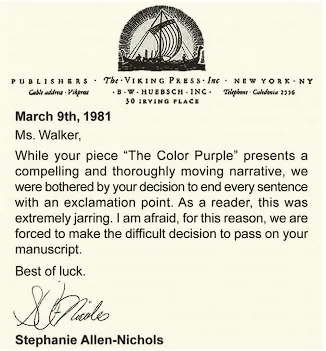
The purpose of editor Stephanie Allen-Nichols' letter to author Alice Walker is to...
to problematize the plot of his work.
to acknowledge receipt of your manuscript.
Request a spelling review of your text.
Inform us of the transfer of your book to another publisher.
to communicate the refusal to publish their novel.
Explicación Oficial / Explicaciones de la Comunidad
Analysis of the Editor's Letter
The correct answer is option A. E) to communicate the refusal to publish their novel.
1. The Key Phrase and the Central Purpose
The main objective of the letter is revealed in its conclusion. The phrase:
- "[...] we are forced to make the difficult decision to pass on your manuscript."
In Portuguese, this translates to:
- "[...we are forced to make the difficult decision to reject your manuscript."
In the editorial context, the expression "to pass on" It's a common and polite euphemism for reject or refuse a job. Therefore, the fundamental purpose of the letter is to inform the author, Alice Walker, that her book will not be published by The Viking Press.
2. Analysis of the Letter's Structure
The letter follows a classic structure for a professional and polite rejection:
-
Initial Praise: The publisher begins by acknowledging the qualities of the work ("presents a compelling and thoroughly moving narrative"). This serves to show that the manuscript was read carefully and that its value was appreciated.
-
Problem Statement (Justification): Next, the publisher points out the specific reason for the rejection. It's not about the story itself, but a stylistic choice: the excessive use of exclamation points, which the publisher considered "extremely jarring."
-
Communication of the Decision: Based on this justification, the final decision to reject the decision is communicated.
3. Evaluation of Alternatives
- A) To problematize the plot of his work: Incorrect. The plot (narrative) is praised, not problematized. * B) Acknowledge receipt of your manuscript: Incorrect. Although the letter confirms receipt, that is not its primary purpose. The primary function is to communicate the result of the evaluation, not just the receipt. * C) Request a spelling review of your text: Incorrect. The problem indicated is... score (Use of exclamation marks), not spelling errors. Furthermore, the letter does not request a revision; it communicates a final decision of refusal. * D) Inform the publisher of the transfer of your book to another publisher: Incorrect. "To pass on" means to refuse, not transfer, or pass on to another person or company. * E) to communicate the refusal to publish their novel: Correct. This is the explicit function of the phrase "pass on your manuscript," which is the climax and the raison d'être of the letter.
4. Conclusion
The letter, despite its polite tone, has a single, unequivocal purpose: to officially inform Mrs. Walker that her manuscript of "The Color Purple" has been rejected for publication by The Viking Press, based on a specific stylistic objection.