
Pregunta de Languages, Codes and their Technologies #019e354a
TEXT I
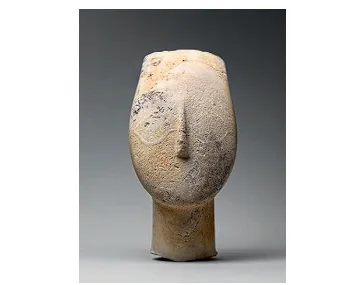
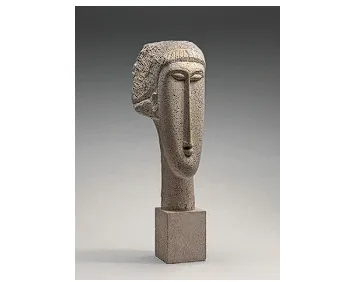
A comparative reading of the two sculptures, separated by more than 2500 years, indicates that
The appreciation of ancient art by contemporary artists.
The resistance of sculptural art to technological advances.
Simplification of form due to the type of material used.
The persistence of aesthetic standards across different eras and cultures.
Absence of detail as a distinguishing feature of traditional folk art.
Explicación Oficial / Explicaciones de la Comunidad
Comparative Analysis of the Sculptures
The correct answer is option A. D) Persistence of aesthetic patterns across different eras and cultures.
1. Comparative Analysis
The question invites us to compare two works separated by millennia and to draw a conclusion from that comparison.
- Sculpture I (Ancient): It is an extremely simplified and abstract representation of a face. The forms are reduced to the essentials: an oval outline for the head, a prominent vertical line for the nose, and subtle features for the eyes. * Sculpture II (Modern): The work of Modigliani, a leading figure in modern art, is also characterized by intense stylization and simplification. The face is elongated, the nose is long and thin, and the eyes are almond-shaped and without detail. The aim is not realism, but an essential expression of form.
When placed side by side, the similarity in the treatment of the human figure is striking. Both reject meticulous detail and realism in favor of a geometric and simplified form.
2. The Persistence of the Aesthetic Standard
The fact that two cultures, in such distant times, arrived at such similar aesthetic solutions for representing the human face indicates that certain artistic patterns or approaches are not exclusive to a single historical period.
THE simplification of form and the abstraction These are aesthetic patterns that, as the comparison shows, persist or recur throughout the history of art. They did not follow a continuous line (classical Greek and Renaissance art, for example, valued realism), but their reappearance in a modern context demonstrates their strength and endurance as an expressive possibility. The comparison, therefore, reveals this. persistence of aesthetic standards.
3. Evaluation of Other Alternatives
- A) Appreciation of ancient art by contemporary artists: While it is historically true that Modigliani and other modernists were influenced by ancient and "primitive" art, option D is a more direct conclusion from the simple visual comparison"Pattern persistence" is what is... observe; "appreciation" is the historical explanation For this observation, option D describes the phenomenon, while option A explains its cause. * B) Resistance of sculptural art to technological advances: The choice of style has no relation to a supposed resistance to technology. * C) Simplification of form due to the type of material used: Incorrect. Simplification is a deliberate stylistic choice, not a material limitation. Both marble and limestone can be sculpted with a very high degree of detail. * E) Absence of detail as a distinguishing feature of traditional folk art: Incorrect. That's a false generalization; many forms of traditional art are extremely detailed.
4. Conclusion
A comparative reading of the two works, one ancient and the other modern, reveals forcefully that certain aesthetic patterns, such as abstraction and the simplification of the human form, are not limited to a single time or place, but demonstrate a remarkable capacity to... persist and resurface in different eras and cultural contexts.