
Pregunta de Natural Sciences and their Technologies #019e354a
A nimesulida é um fármaco pouco solúvel em água, utilizado como anti-inflamatório, analgésico e antitérmico. Ela possui caráter fracamente ácido em razão do grupo sulfonamida presente em sua estrutura molecular. Em meio aquoso alcalino, contendo uma base de Brönsted-Lowry, ocorre a desprotonação desse grupo, formando uma espécie aniônica que favorece a dissolução do fármaco.
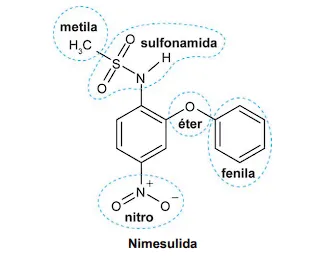
In the structure of this drug, the group capable of reacting with the Brönsted-Lowry base is the group
sulfonamide.
methyl.
phenyl.
nitro.
ether.
Explicación Oficial / Explicaciones de la Comunidad
Analysis of the Acid-Base Reactivity of Nimesulide
The correct answer is option A. A) sulfonamide.
1. The Nature of the Proposed Reaction
The statement describes an acid-base reaction according to the Brönsted-Lowry theory:
- Brönsted-Lowry base: It is a chemical species that captures (accepts) a proton (H⁺). * Brönsted-Lowry acid: For the base to react, nimesulide must act as an acid, that is, it must be able to... donate a proton (H⁺).
Therefore, the question boils down to identifying which of the groups present in the nimesulide molecule has the most acidic hydrogen, that is, the hydrogen that can be most easily donated to a base.
2. Evaluation of Functional Groups
Let's analyze the acidity of each group indicated in the molecule:
-
A) Sulfonamide (-SO₂NH-): This is the correct group. The hydrogen atom bonded to nitrogen (N-HThe compound is remarkably acidic. This is because the sulfonyl group (-SO₂) is a strongly electron-withdrawing group. It "pulls" the electron density from the nitrogen atom, weakening the NH bond and facilitating the departure of hydrogen as H⁺. Furthermore, the conjugate base formed after the loss of the proton (the negatively charged anion on the nitrogen) is stabilized by resonance with the oxygens of the sulfonyl group, making the initial proton even more acidic. This is the site of the reaction.
-
B) Methyl (-CH₃): Incorrect. Hydrogens bonded to a carbon in an alkyl group like methyl are not acidic. The CH bonds are very stable and difficult to break to release an H⁺.
-
C) Phenyl (Aromatic Ring): Incorrect. The hydrogens directly bonded to the carbons of the aromatic ring are not acidic under normal conditions. Their removal would require much more drastic reaction conditions.
-
D) Nitrogen (-NO₂): Incorrect. Although the nitro group is a strong electron-withdrawing group, it does not have any hydrogen atoms to donate.
-
E) Ether (-O-): Incorrect. The oxygen atom in the ether group is bonded to two carbon atoms and does not have any hydrogens directly bonded to it that can be donated.
3. The Effect on Solubility
When a base reacts with nimesulide, it removes the proton (H⁺) from the sulfonamide group. The molecule, which was neutral, transforms into an anion (a species with a negative electrical charge).
Nimesulide-H + Base ⇌ [Nimesulide]⁻ + Base-H⁺
Ionic (charged) compounds are generally much more soluble in polar solvents, such as water, than their neutral counterparts. This is why treatment with a base increases the solubility of nimesulide, as mentioned in the statement.
4. Conclusion
The group sulfonamide It is the only component in the nimesulide structure that possesses a proton acidic enough to react with a Brönsted-Lowry base under mild conditions, resulting in the formation of a charged species that is more soluble in water.