
Pregunta de Natural Sciences and their Technologies #019e354b
O Cerrado e a Amazônia abrigam grande número de serpentes popularmente conhecidas como cobras-corais. Embora pertençam a famílias distintas, as corais-verdadeiras (venenosas) e as falsas-corais (não peçonhentas) apresentam padrão de coloração semelhante, com anéis pretos, vermelhos e brancos/amarelos ao longo do corpo. Nas fotografias, são apresentados exemplos dessas serpentes: uma coral-verdadeira e uma falsa-coral.
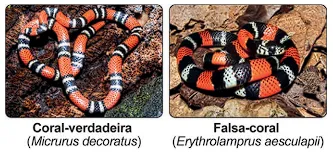
What is the advantage of this similarity for false coral snakes?
It facilitates the capture of prey.
It reduces competition for resources.
It allows for the generation of hybrid individuals.
It reduces the possibility of them being preyed upon.
It optimizes the matching of reproductive partners.
Explicación Oficial / Explicaciones de la Comunidad
Analysis of Mimicry in Coral Snakes
The correct answer is option A. D) It reduces the possibility of them being preyed upon.
1. The Ecological Phenomenon: Aposematism and Batesian Mimicry
To understand the advantage, we need two key concepts from ecology:
-
Aposematism (Warning Coloration): The coral snake is venomous. Its vibrant color pattern (red, black, white/yellow) is not for hiding, but rather to stand out. This coloration acts as a warning signal to potential predators, communicating: "I am dangerous, do not attack me." Predators that attempt to attack a coral snake learn (if they survive) to associate that color pattern with a negative experience.
-
Batesian Mimicry: This is the phenomenon that occurs with the false coral snake. In this type of mimicry, a harmless species (the "mimic," which is the false coral snake) evolves to resemble a dangerous species (the "model," which is the true coral snake).
2. The Specific Advantage for the False Coral
The false coral snake, being harmless, would not have an effective defense against predators. However, by "copying" the appearance of the true coral snake, it benefits from the dangerous reputation of its model.
The mechanism is as follows: 1. A predator learns to avoid the color pattern of the coral snake. 2. When this same predator encounters a false coral snake, it cannot distinguish between the two. 3. As a precaution, the predator avoids attacking the false coral snake, treating it as if it were a venomous snake.
In this way, the similarity acts as a "disguise" that deceives predators, giving the false coral snake very effective protection and significantly reducing the chance of it being preyed upon.
3. Evaluation of Other Alternatives
- A) Facilitates the capture of prey: Incorrect. Warning coloration makes the snake more visible, which would actually hinder ambush hunting. * B) It reduces competition for resources: Incorrect. Appearance has no direct effect on competition for food, territory, or other resources with other species. * C) It allows the generation of hybrid individuals: Incorrect. They are distinct species of different genera (Micrurus and ErythrolamprusThe similarity is only external (phenotypic); they cannot interbreed and produce offspring. * E) Optimizes the matching of reproductive partners: Incorrect. The identification of mating partners in snakes is guided primarily by chemical signals (pheromones), not by coloration.
4. Conclusion
The similarity between the false coral snake and the true coral snake is a classic example of Batesian mimicry. The advantage gained by the false coral snake is purely defensive: it uses the "reputation" of the venomous species to scare away its own predators and increase its chances of survival.