
Questão de Humanities and their Technologies #019e354a
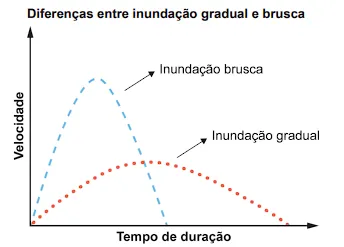
The disproportion between speed and duration in the highlighted types of flooding is conditioned by
annual solar variability.
average monthly temperature.
slope of the local terrain.
regional tectonic dynamics.
Gradation of river turbidity.
Explicação Oficial / Explicações da Comunidade
Analysis of the Graph on Flood Types
The correct answer is option A. C) slope of the local terrain.
1. Graph Interpretation
The graph presents the characteristics of two types of flooding, relating them to... speed of the water with the duration about the event:
- Flash Flood (Lightning Flood): It is characterized by achieving a high speed in a short period of timeThe total duration of the event is also short. * Gradual Flooding: It is characterized by having a low speed, with the peak being reached slowly over a period of time. long periodThe total duration is extensive.
The question seeks to identify the main geographical factor that conditions (determines) this drastic difference in the behavior of the water.
2. The Influence of Slope
THE slopeThe slope, or inclination of the terrain, is the most direct factor controlling the speed of water runoff.
- In terrains with a high slope (steep terrain, such as mountainous or hilly areas): The force of gravity acts more intensely, causing rainwater to run off the surface very quickly. There is no time for the water to infiltrate the soil, which generates a sudden increase in the volume and speed of the rivers. This results in a flash flood. * In terrains with low slopes (flat terrain, such as plains and wide valleys): The water drains slowly, spreading across the surface. This allows a greater portion of the water to infiltrate the soil. The rise in river levels is slow and progressive, resulting in a... gradual flooding.
Therefore, the disproportion between the two types of flooding is directly conditioned by the topography of the location.
3. Evaluation of Other Alternatives
- A) Annual solar variability: Solar radiation influences the climate and the seasons, but it does not determine the speed at which water flows over a specific terrain. * B) Average monthly temperature: Temperature affects evaporation, but it is not the primary factor controlling the speed of surface runoff during heavy rainfall. * D) Regional tectonic dynamics: Tectonics creates landforms over millions of years, but the immediate characteristic that influences flooding is the result of this process (the slope), and not the dynamics themselves. * E) Gradation of river turbidity: Turbidity (the amount of suspended sediment) is a consequence the speed of the water (faster waters carry more sediment), and not its cause.
4. Conclusion
THE slope of the local terrain It is the main factor that determines whether a flood will be sudden (quick and short, on steep terrain) or gradual (slow and long, on flat terrain).