
Questão de Humanities and their Technologies #019e354a
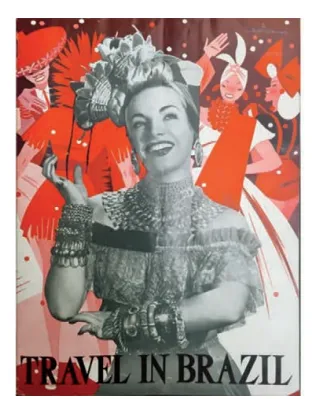
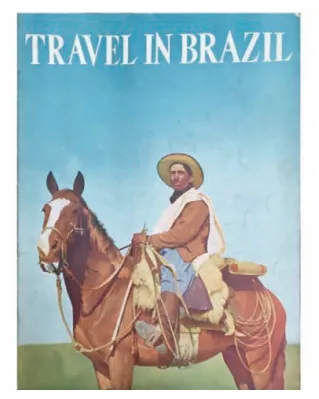
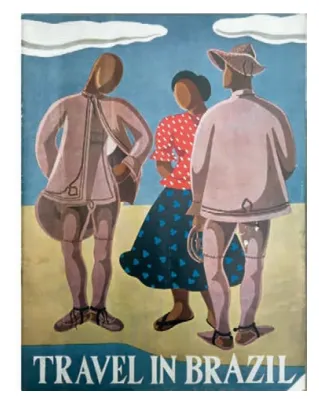
What do the covers of Travel in Brazil magazine, published between 1941 and 1944 by the Department of Press and Propaganda (DIP), reveal?
stereotypes of national culture.
exploitation of the poor population.
racial prejudices.
Media censorship policy.
industrial country project.
Explicação Oficial / Explicações da Comunidade
Analysis of the Covers of "Travel in Brazil" Magazine
The correct answer is option A. A) Stereotypes of national culture.
1. Analysis of the Images and Historical Context
The covers of "Travel in Brazil" magazine, produced by the Department of Press and Propaganda (DIP) during the Estado Novo (1937-1945), are pieces of state propaganda. The DIP's objective was to construct and promote a specific image of Brazil, especially for foreign audiences. To this end, the visual strategy adopted was to select and idealize figures and themes that were easily recognizable and attractive.
- Cover 1: It depicts a smiling woman dressed as a "baiana" (a traditional Bahian woman), in a Carnival setting. This image evokes joy, music (samba), and the exoticization of the Brazilian woman, in a style that was popularized internationally by Carmen Miranda around the same time. * Cover 2: It depicts the figure of the "gaucho" on horseback, symbolizing the tradition, rural life, and regional identity of southern Brazil. * Cover 3: It depicts popular figures, likely from the Northeast of Brazil, stylized in a modernist aesthetic. The image evokes folklore and regional traditions.
2. The Construction of Stereotypes
What these three covers have in common is the use of stereotypesA stereotype is a simplified, generalized, and idealized representation of a group or culture. The figures of the carnival "Bahian woman," the "Gaucho," and folkloric characters are used not to show the complexity of Brazilian reality, but to create icons that are easily "consumable" by an external audience.
By choosing these images, the DIP (Department of Press and Propaganda) was deliberately constructing a national identity based on cultural stereotypes: Brazil as an exotic, festive, folkloric, and traditional country.
3. Evaluation of Other Alternatives
- B) Exploitation of the poor population: Incorrect. The images are idealized and celebratory. The goal of the propaganda was to hide social problems, such as poverty and exploitation, not to highlight them. * C) Racial prejudices: Incorrect. While creating stereotypes can be a form of prejudice, the primary intention of the covers is not to demean, but rather to exoticize and celebrate these figures in a superficial way for advertising purposes. * D) Media censorship policy: Incorrect. Although the DIP was the regime's censorship body, these covers are an example of propaganda (the creation and dissemination of a message), and not censorship (the suppression of a message). * E) Project for an industrial country: Incorrect. The covers show the exact opposite. They value Brazil's folklore, rural and traditional aspects, completely ignoring the modernization and industrialization project that was also on the Vargas government's agenda.
4. Conclusion
The covers of "Travel in Brazil" magazine highlight the use of stereotypes of national culture as a propaganda tool of the Estado Novo regime to construct and disseminate an idealized, exotic, and attractive image of Brazil to the outside world.