
Questão de Natural Sciences and their Technologies #019e354a
Microbial fuel cells (MFCs) are capable of generating electricity from urban and agro-industrial wastewater. MFCs consist of two chambers. In one of them, where organic matter is treated, electrogenic bacteria grow, forming a biofilm and feeding on the pollutants present in the effluent. As they feed, these bacteria generate an electric current that flows through the material on which they formed the biofilm. An external conducting wire allows this current to migrate to a second chamber, promoting a chemical reaction. The figure schematically illustrates an MFC and the reactions involved.
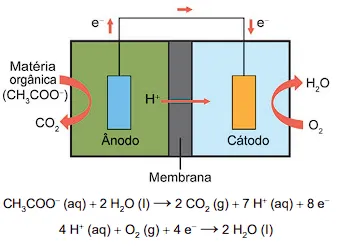
Which of the equations represents the overall reaction that occurs during the operation of this CCM?
CH3COO− (aq) + O2 (g) → 2 CO2 (g) + 3 H+ (aq)
CO2 (g) + O2 (g) + H+ (aq) → H2O (l) + CH3COO− (aq)
CH3 COO− (aq) + H+ (aq) + 2 O2 (g) → 2 CO2 (g) + 2 H2O (l)
CH3 COO− (aq) + 6 H2O (l) → 2 CO2 (g) + 2 O2 (g) + 15 H+ (aq)
2 CO2 (g) + 11 H+ (aq) + O2 (g) → CH3COO− (aq) + 4 H2O (l)
Explicação Oficial / Explicações da Comunidade
Microbial Fuel Cell (MFC) Analysis
The correct answer is option A. C) CH₃COO⁻ (aq) + H⁺ (aq) + 2 O₂ (g) → 2 CO₂ (g) + 2 H₂O (l)
1. Identification of Half-Reactions
To find the overall reaction, we need to combine the two half-reactions provided, one that occurs at the anode (oxidation) and the other at the cathode (reduction).
-
Oxidation Half-Reaction (at the Anode):
CH₃COO⁻ (aq) + 2 H₂O (l) → 2 CO₂ (g) + 7 H⁺ (aq) + 8 e⁻ -
Reduction Half-Reaction (at the Cathode):
4 H⁺ (aq) + O₂ (g) + 4 e⁻ → 2 H₂O (l)
2. Electron Balancing
The number of electrons (e⁻) released in oxidation must be equal to the number of electrons consumed in reduction.
- The oxidation reaction releases 8 electrons. * The reduction reaction consumes 4 electrons.
To equalize the number of electrons, we need to multiply the entire reduction half-reaction by 2.
2 * [4 H⁺ (aq) + O₂ (g) + 4 e⁻ → 2 H₂O (l)]* Resulting in:8 H⁺ (aq) + 2 O₂ (g) + 8 e⁻ → 4 H₂O (l)
3. Sum of Balanced Half-Reactions
Now, we add the two half-reactions (the original oxidation half-reaction and the reduction half-reaction multiplied by 2), combining all the reactants on one side and all the products on the other.
Reagents: CH₃COO⁻ (aq) + 2 H₂O (l) + 8 H⁺ (aq) + 2 O₂ (g) + 8 e⁻ Products: 2 CO₂ (g) + 7 H⁺ (aq) + 8 e⁻ + 4 H₂O (l)
The equation becomes: CH₃COO⁻ + 2 H₂O + 8 H⁺ + 2 O₂ + 8 e⁻ → 2 CO₂ + 7 H⁺ + 8 e⁻ + 4 H₂O
4. Simplifying the Global Equation
Finally, we cancel out the species that appear on both sides of the equation:
- Electrons (e⁻): We cancelled the
8 e⁻on each side. * H⁺ ions: We cancelled.7 H⁺on each side, leaving1 H⁺on the reactants side. * Water (H₂O): We cancelled.2 H₂Oon each side, leaving2 H₂Oon the product side.
The final simplified global equation is:
CH₃COO⁻ (aq) + H⁺ (aq) + 2 O₂ (g) → 2 CO₂ (g) + 2 H₂O (l)
This equation corresponds exactly to the alternative. W.