
Questão de Natural Sciences and their Technologies #019e354a
In automobiles, it is important to ensure that the center of mass (CM) of each wheel/tire assembly coincides with its geometric center. This process is performed on a balancing machine, in which the wheel and tire assembly is set to rotate at a constant speed. Based on the measured oscillations, the machine indicates the position of the assembly's center of mass, and small lead weights are fixed at specific points on the wheel until the vibrations decrease. During his team's training, in order to correct the center of mass position indicated by the machine, a mechanic presents the following diagram, with five possible points on the wheel to position a lead weight.
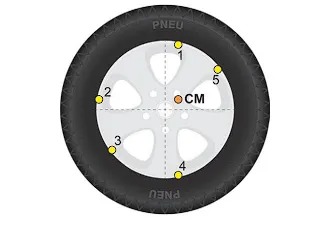
At what point should the lead piece be fixed to correct the position of the center of mass of this wheel/tire assembly?
1
2
3
4
5
Explicação Oficial / Explicações da Comunidade
Wheel Balancing Analysis
The correct answer is option A. C) 3.
1. Understanding the Problem: Center of Mass and Unbalance
- Center of Mass (CM): It is the point that represents the average position of all the mass of an object. In a perfectly symmetrical object with uniform density, such as an ideal wheel, the center of mass coincides exactly with its geometric center (the center of the axis). * Imbalance: The image shows that the Center of Mass (CM) of the wheel/tire assembly is displaced from the geometric center. This means there is an uneven distribution of mass. Specifically, there is a excess mass in the region to which the center of mass (CM) moved, which, in the case of the figure, is the upper right quadrant. * Consequence: When this wheel rotates at high speed, this excess of decentralized mass causes a resultant force that constantly changes direction, generating the vibrations and oscillations mentioned in the text.
2. The Principle of Correction: The Counterweight
The goal of balancing is to make the center of mass of the final system (wheel + tire + lead piece) coincide again with the geometric center.
To correct for excess mass on one side of a rotation axis, the solution is to add mass to that side. diametrically opposedThis additional mass will function as a counterweight, "pulling" the overall center of mass back toward the center.
3. Analysis of the Figure and Points
- Identifying the Imbalance: The center of mass (CM) is in the upper right quadrant, indicating an excess of mass in that region. 2. Determine the opposite position: The position diametrically opposite the upper right quadrant is the lower left quadrant. 3. Locate the Correction Point: Looking at the options on the wheel: * THE Point 3 It is the only one located in the lower left quadrant, exactly opposite the imbalance. * Placing a weight at Points 1 or 5 would aggravate the problem or displace it, as it would add more mass near the region that is already in excess. * Placing a weight on Points 2 or 4 would not effectively solve the problem, as they are not in directly opposite positions to counteract the imbalance.
4. Conclusion
To correct the position of the center of mass and eliminate vibrations, the lead piece must be fixed in place. point 3, which acts as a counterweight to the excess mass on the opposite side of the wheel, realigning the center of mass of the assembly with its geometric center.```