
Questão de Natural Sciences and their Technologies #019e354a
Although the animals represented in the cladogram share a common ancestor, they are characterized by distinct patterns of reproduction or nutrition of embryos and offspring.
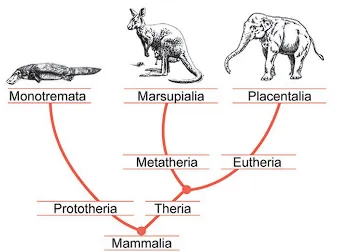
Throughout the evolutionary process, losses and gains are observed among these animals in the aforementioned patterns involving the(a)
increase in the number of offspring per litter.
Change in the type of fertilization from external to internal.
Reduction in reproductive versatility, which becomes exclusively sexual.
embryonic development, which transitions from an aquatic to a terrestrial environment.
Decreased yolk sac size, associated with the development of lactation.
Explicação Oficial / Explicações da Comunidade
Analysis of the Reproductive Evolution of Mammals
The correct answer is option A. E) Decreased yolk sac size, associated with the development of lactation.
1. Interpreting the Cladogram and the Question
The cladogram shows the evolutionary relationship between the three major groups of mammals: * Prototheria (Monotremes): Represented by the platypus, these are mammals that lay eggs. * Metatheria (Marsupials): Represented by the kangaroo, they give birth to very underdeveloped offspring that complete their development in a pouch (marsupium). * Eutheria (Placental Mammals): Represented by the elephant, they have a long gestation period with the development of a complex placenta, giving birth to more developed offspring.
The question asks to identify an evolutionary trend (losses and gains) related to the reproductive and nutritional patterns of embryos and offspring, following the line from the common ancestor to placental mammals.
2. The Evolution of Embryonic and Postnatal Nutrition
-
Common Ancestor and Monotremes: The ancestors of mammals, as well as modern monotremes, were oviparous. Their eggs contained a large yolk sac (yolk sac) rich in nutrients (yolk), which was the main source of energy for the development of the embryo inside the egg.
-
Transition to Viviparity (Marsupials and Placentals): With the evolution of viviparity (giving birth to live young), the dependence on yolk sac decreased drastically. * Marsupials: The embryo spends a very short time in the uterus, nourished by a rudimentary placenta (often called the choriovitelline placenta), and is born at an almost fetal stage. The main source of nutrition for its complex development is the breast milk, obtained while it is in the stock market. * Placentals: The evolution of a complex and efficient placenta allowed the embryo to remain in the uterus for much longer, receiving all the nutrients directly from the mother.
-
The Inverse Relationship: Throughout this evolutionary process, a clear trend can be observed: as the nutrition provided by the mother (first through milk and then through the placenta and milk) became more sophisticated and prolonged, the need for a large store of nutrients in the egg (yolk) decreased. This led to a progressive reduction of the yolk sacA **lactation (milk production)**The yolk sac, present in all mammals, has become the universal and fundamental method of postnatal nutrition, compensating for the loss of the nutritive function of the yolk.
3. Evaluation of Other Alternatives
- A) Increase in the number of offspring per litter: Incorrect. The evolutionary trend in mammals, especially in lineages such as primates and elephants, is one of... reduction in litter size, with greater parental investment resulting in fewer offspring. * B) Change in the type of fertilization from external to internal: Incorrect. Internal fertilization was already a characteristic of the reptilian ancestors of mammals and is present in all groups of the cladogram. It is not a change that occurred. between these animals. * C) Reduced reproductive versatility, which becomes exclusively sexual: Incorrect. Sexual reproduction is the norm for the vast majority of vertebrates, including the ancestors of mammals. There has been no loss of versatility in this regard. * D) embryonic development, which transitions from an aquatic to a terrestrial environment: Incorrect. Mammals are a fundamentally terrestrial group in origin. The embryonic development of mammalian ancestors already occurred in a terrestrial environment (inside eggs with shells).
4. Conclusion
The main evolutionary transition in offspring reproduction and nutrition, as illustrated in the cladogram, involves the shift from dependence on a yolk-rich egg to dependence on maternal nutrition. This manifests itself through... shrinkage of the yolk sac, which loses its primary function of nutrition, and due to evolutionary gains and improvements in lactation as a new strategy for feeding the puppies.