
Questão de Natural Sciences and their Technologies #019e354a
Mirascope 3D: Producer of instant illusion
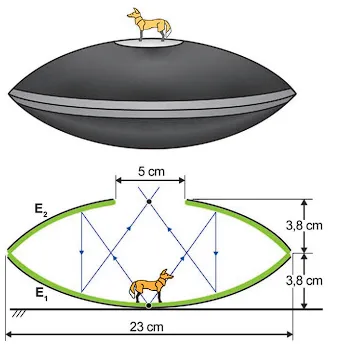
The nature of the image formed and the vertical distance between each object point and its corresponding image point are...
real and 5 cm.
Actual size is 3.8 cm.
Actual size is 7.6 cm.
virtual and 7.6 cm.
virtual and 3.8 cm.
Explicação Oficial / Explicações da Comunidade
Mirascope 3D Analysis
The correct answer is option A. C) actual and 7.6 cm.
1. The Nature of the Image: Real
To determine whether an image is real or virtual, we need to understand how it is formed.
-
First Reflection (Mirror E₂): The object is positioned at the vertex of E₁, which, according to the statement, is the mirror focus E₂A fundamental property of concave mirrors is that every ray of light emanating from their focus is reflected parallel to the principal axis. Therefore, after the first reflection at E₂, the light rays travel downwards, parallel to each other.
-
Second Reflection (Mirror E₁): These parallel rays descend and strike the surface of the concave mirror E₁. Another fundamental property of concave mirrors is that every ray of light incident parallel to the principal axis is reflected towards the focusThe statement says that the circular opening (vertex of E₂) is the focus of mirror E₁.
-
Image Formation: The rays, after being reflected by E₁, all converge to a single point: the focus of E₁, which is exactly the upper opening of the device.
How the final image is formed by effective meeting (convergence) of light raysIt is classified as an image. realVirtual images are formed by extending rays where they appear to intersect, but do not physically do so. The fact that the image appears to "float in the air" and can be viewed from various angles is a characteristic of a real three-dimensional image.
2. Calculating Vertical Distance
The question asks for the vertical distance between a point on the object and its corresponding point on the image.
-
Object Position: The object is positioned on the vertex of the lower mirror, E₁. The diagram shows that the "height" of this mirror, from its vertex to the meeting edge, is 3.8 cm.
-
Image Position: The image is formed in the upper circular opening, which is the vertex of the upper mirror, E₂. The diagram shows that the "height" of this mirror, from its vertex to the meeting edge, is also... 3.8 cm.
The total vertical distance between the object and the image is the sum of these two heights.
- Vertical Distance = (Height of E₁) + (Height of E₂) * Vertical Distance = 3.8 cm + 3.8 cm = 7.6 cm
3. Conclusion
The image formed by the mirascope is realThis results from the physical convergence of light rays. The vertical distance between the object at the back of the apparatus and the image formed at the aperture is the sum of the heights of the two mirrors, totaling 7.6 cm.