
Questão de Natural Sciences and their Technologies #019e354b
Um dos exemplos mais conhecidos de herança recessiva ligada ao cromossomo X é o daltonismo. Como em qualquer distúrbio recessivo ligado ao cromossomo X, existem muito mais homens apresentando o fenótipo com esse tipo de daltonismo do que mulheres. Um casal formado por um homem não daltônico e por uma mulher gestante também não daltônica, mas portadora do gene recessivo para esse tipo de daltonismo, está esperando um bebê. Em uma das consultas de pré-natal, o casal recebeu um heredograma que contém todas as possibilidades de genótipo para esse bebê.
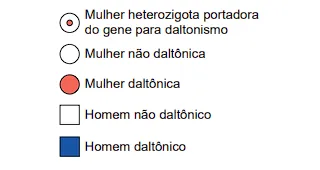
Considere a legenda:
- Círculo com ponto central: Mulher heterozigota portadora do gene para daltonismo
- Círculo branco: Mulher não daltônica
- Círculo vermelho: Mulher daltônica
- Quadrado branco: Homem não daltônico
- Quadrado azul: Homem daltônico
GRIFFITHS, A. et al. Introdução à genética. Rio de Janeiro: Guanabara Koogan, 2016 (adaptado).
What pedigree did the couple receive?
I
II
III
IV
V
Explicação Oficial / Explicações da Comunidade
Analysis of the Color Blindness Pedigree
The correct answer is the pedigree chart of the alternative. B.
1. Understanding the Genetics of Color Blindness
According to the statement, color blindness is a recessive trait linked to the X chromosome. Let's define the alleles:
- Xᴰ: Dominant allele, responsible for normal vision. * Xᵈ: Recessive allele, responsible for color blindness.
Based on this, the possible genotypes are:
- Woman: * XᴰXᴰ: Not colorblind (homozygous dominant). * XᴰXᵈ: Not colorblind, but a carrier (heterozygous). * XdXd: Colorblind. * Man: * XᴰY: Not colorblind. * XᵈY: Colorblind.
2. Determining the Parents' Genotype
The problem describes the couple as follows:
- The father: "non-colorblind man". Therefore, his genotype can only be XTY. * The mother: "The pregnant woman is not colorblind, but carries the recessive gene." This means she is heterozygous, and her genotype is XᴰXᵈ.
3. Prediction of Offspring (Crossing)
We will perform the cross between the parents (XᴰXᵈ vs. XᴰY) using the Punnett square to find all possible genotypes for the baby:
| | Xᴰ (from the father) | Y (from the father) | | :--- | :--- | :--- | | Xᴰ (from the mother) XᴰXᴰ | XTY | | Xᵈ (from the mother) XᴰXᵈ | XDY |
4. Translating Genotypes into Pedigree Symbols
Now, let's associate each possible genotype of the baby with its corresponding symbol in the legend:
- XᴰXᴰ: This corresponds to a "Non-colorblind woman" (white circle). * XᴰXᵈ: This corresponds to a "Heterozygous woman carrying the gene for color blindness" (circle with a red dot). * XTY: This corresponds to a "non-colorblind man" (white square). * XDY: This corresponds to a "Colorblind Man" (blue square).
5. Conclusion
The pedigree that correctly represents all possibilities for the baby must contain these four descendants. When analyzing the options:
- Pedigree A: Incorrect. It presents a colorblind woman (XᵈXᵈ), which is impossible, since the father (XᴰY) does not have the Xᵈ allele to transmit to his daughter. * Pedigree B: Correct. It presents exactly the four possible outcomes of the cross: a non-colorblind woman, a carrier woman, a non-colorblind man, and a colorblind man. * Pedigree C: Incorrect. The possibilities for a non-colorblind woman (XᴰXᴰ) and a colorblind man (XᵈY) are missing. * Pedigree D: Incorrect. The possibilities for a colorblind woman (XᴰXᵈ) and a non-colorblind man (XᴰY) are missing. * Pedigree chart E: Incorrect. It depicts two colorblind women, which is impossible.
Therefore, the pedigree received by the couple was that of alternative B.