
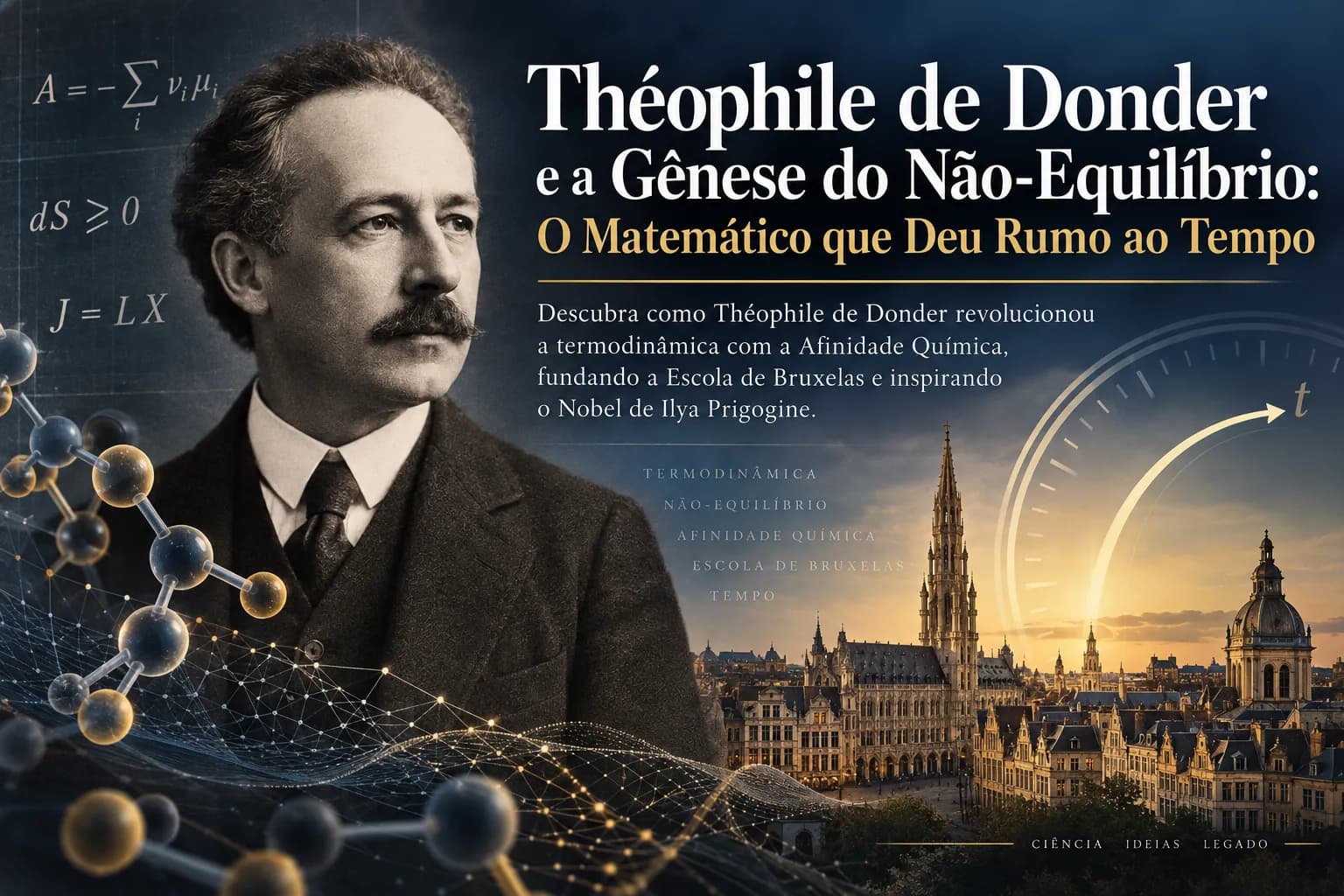
The Mathematician in Physics' Most Famous Photo: The Forgotten Architect of Time
In October 1927, the gardens of Léopold Park in Brussels served as the setting for the most celebrated conclave in the history of modern science: the 5th Solvay Physics Council. In the legendary official photograph of the event, twenty-nine extraordinary minds face posterity. Most historical gazes converge on the titanic duel between Albert Einstein and Niels Bohr over the probabilistic interpretation of Quantum Mechanics, or on the austere presence of Hendrik Lorentz and Marie Curie in the front row.
However, strategically positioned in the second row, right behind Einstein and next to Erwin Schrödinger, rests an elegant figure with a thick mustache and penetrating gaze: the Belgian mathematician and theoretical physicist. Théophile de Donder (1872–1957).
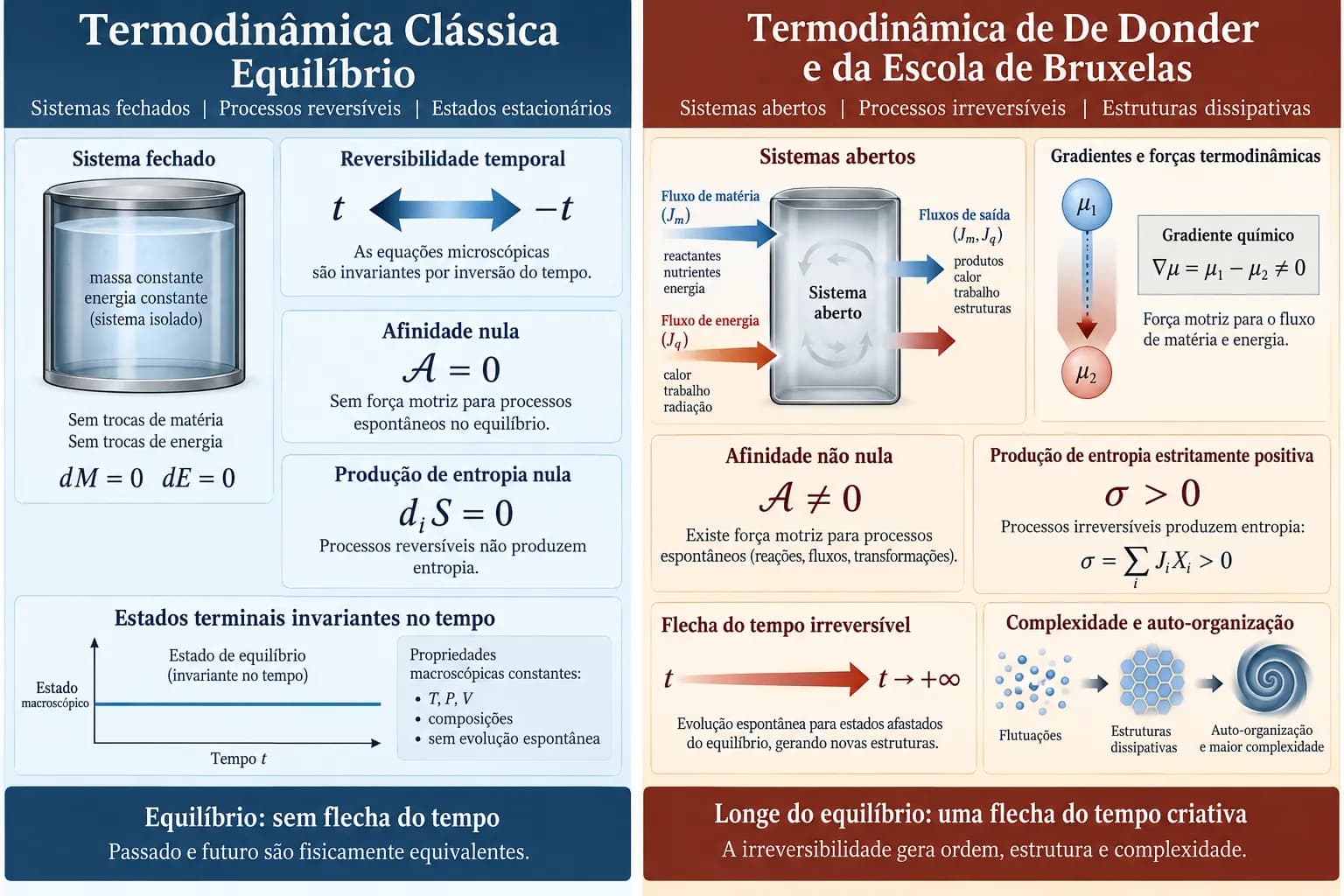
While the physics canon of the time focused on wave-particle duality and the static geometry of relativistic spacetime—both governed by strictly temporally reversible equations—De Donder contemplated an epistemological abyss that fundamental physics insisted on circumventing: **The real world burns, flows, transforms, and ages.**Classical mathematical physics had conceived of a cosmos in which time was a symmetrical illusion of coordinates, but in living matter and chemical reactions, time possessed a relentless and creative arrow.
Classical thermodynamics is essentially a theory of structure destruction... Non-equilibrium thermodynamics, on the other hand, is a theory of structure creation.
The uniqueness of Théophile de Donder's trajectory lies in the fact that he was not an empirical laboratory chemist, but a rigorous mathematical analyst forged in the most abstract variational principles. Inspired by the tensor calculus of Einstein's General Relativity and the analytical sophistication of Henri Poincaré, De Donder realized that the classical thermodynamics of the 19th century—of Sadi Carnot, Rudolf Clausius, and Josiah Willard Gibbs—had achieved monumental precision at the cost of sterile immobility: it described only ideal equilibrium states or infinitely slow (quasi-static) transformations, in which nothing truly new could emerge.
By challenging the disciplinary consensus of his time, De Donder undertook the herculean task of constructing the exact mathematical formalism for real, spontaneous, and irreversible transformations, laying the foundation for the celebrated... Brussels School of Thermodynamics in Université Libre de Bruxelles (ULB).
From Pure Analysis to Chemical Affinity: The Disciplinary Tension
At the beginning of the 20th century, traditional physical chemistry viewed with skepticism the encroachment of abstract mathematical formalism into its thermochemical domains. Chemical affinity was often treated as a nebulous and semi-anthropomorphic concept, a vague tendency of elements to combine inherited from alchemists and reformulated discontinuously by Hermann von Helmholtz and Jacobus Henricus van 't Hoff.
De Donder understood that, in order to integrate chemistry with analytical mechanics and relativity, it was imperative to quantify the... motive power of a reaction out of equilibrium by means of a dynamic state variable. He introduced, with axiomatic rigor, two complementary variables that transformed modern thermodynamics:
- THE degree of advancement of the reaction (ξ), which quantifies the microscopic and macroscopic evolution of molecular transformation;
- THE Chemical Affinity (A), a generalized force in the Lagrangian sense, defined as the partial derivative of free energy with respect to the degree of advance.
Exegesis of De Donder's Affinity
In the fundamental De Donder equation, each term carries a crucial physical and chemical meaning:
- uk represents the stoichiometric coefficients of the reactants (conventionally considered negative) and the products (positive);
- μk designates the chemical potentials of the species k present in the reaction system at a given instant.
The magnitude and sign of A unequivocally define the dynamics of the system:
- When A=0, the system reaches the static state of chemical equilibrium predicted by Gibbs, where the thermodynamic tendencies cancel each other out;
- When A>0, the reaction proceeds spontaneously in the forward direction (dtdξ>0), driven by a positive motive voltage;
- When A<0, the reaction can only proceed in the reverse direction (dtdξ<0).
For the first time, chemical thermodynamics ceased to be a catalog of static final states and became a theory of dynamic forces and flows.
The Production of Entropy and the Arrow of Time
The Second Law of Thermodynamics, as classically stated by Rudolf Clausius in the formula dS≥TdQ, contained an inequality that was troublesome to the mathematical mind: the inequality indicated the direction of natural transformations, but remained silent about the exact rate of irreversibility generation.
De Donder broke this impasse by decomposing the total entropy variation (dS) of any open or closed system into two additive contributions of distinct ontological natures:
dS=dandS+diS
- dandS is the flow of entropy exchanged across the system boundaries with the external environment (which can be positive, negative, or zero);
- diS is a internal production of entropy, resulting exclusively from irreversible processes occurring within the system, subject to the strict restriction diS≥0.
By associating the internal production of entropy with Chemical Affinity A and the rate of advance dtdξ, De Donder formulated the exact expression for the temporal dissipation of energy:
Solvay 1927 and the Passing of the Baton to Ilya Prigogine
At the historic 5th Solvay Congress of 1927, Théophile de Donder played a catalytic role. He maintained regular correspondence with Albert Einstein on the variational formulation of gravitation and continuous electrodynamics, seeking an elegant unification between covariant relativity and relativistic thermodynamics. For De Donder, physics could not be sliced into watertight compartments: the laws that curve the cosmological fabric and the differential equations that govern the affinity between two molecules derived from the same profound mathematical harmony.
It was in this intellectually vibrant environment in Université Libre de Bruxelles that De Donder welcomed, in the late 1930s, a young and brilliant refugee of Russian origin: Ilya Prigogine (1917–2003). Impressed by the depth of the concept of affinity and by the formulation of diS, Prigogine embraced his mentor's research program and expanded it to previously unimaginable horizons.
Prigogine first systematized the linear regime of non-equilibrium thermodynamics (formulating the Minimum Entropy Production Theorem). Next, when confronting systems deliberately kept away from thermal equilibrium in non-linear regimes, he discovered that fluctuations and entropy dissipation did not lead to chaotic disorder, but could give rise to highly ordered spatial and temporal patterns: the famous Dissipative Structures.
The ultimate crowning achievement of De Donder's legacy came in 1977, when Ilya Prigogine was awarded the Nobel Prize in Chemistry, publicly dedicating the award to the pioneering framework erected by his mentor in Belgium.
Man's Reconciliation with the Arrow of Time
The epistemological revolution sparked by Théophile de Donder and consummated by the Brussels School radically altered our understanding of the cosmos. The reductionist mechanism of the 18th and 19th centuries viewed the universe as a gigantic clockwork mechanism whose spring inexorably unraveled towards a cold, sterile, and homogeneous 'thermal death'.
By mathematically demonstrating that the production of internal entropy in non-equilibrium processes ($d_(i S > 0) is the primary source of flows, driving forces, and differentiation. De Donder revealed that irreversibility is neither an imperfection in our measurements nor a mere entropic defect. Irreversibility is the architect of complexity, of living chemistry, and of consciousness itself..
Théophile de Donder remains the visionary mathematician who rejected the comfort of static states, looked into the eyes of the giants of Solvay, and unleashed the arrow of time so that science could finally comprehend the exuberance of becoming.
Irreversibility plays an essential constructive role in nature. Far from equilibrium, matter acquires new properties, where time itself becomes creation.
Referencias
De Donder, T. (1927). L'Affinité. Paris: Gauthier-Villars. De Donder, T., & Van Rysselberghe, P. (1936). Thermodynamic Theory of Affinity: A Book of Principles. Stanford: Stanford University Press. Glansdorff, P., & Prigogine, I. (1971). Thermodynamic Theory of Structure, Stability and Fluctuations. London: Wiley-Interscience. Mehra, J. (1975). The Solvay Conferences on Physics: Aspects of the Development of Physics Since 1911. Dordrecht: D. Reidel Publishing Company. Prigogine, I., & Stengers, I. (1984). Order out of Chaos: Man's New Dialogue with Nature. New York: Bantam Books.