
Pregunta de Natural Sciences and their Technologies #019e354b
As autoridades sanitárias brasileiras têm se preocupado muito nos últimos anos com o aumento da ocorrência de doenças transmitidas por mosquitos, principalmente arboviroses como chikungunya e zika, que se tornaram epidêmicas ou endêmicas em áreas urbanas. Parte de uma análise da relação entre a urbanização e a incidência dessas doenças está representada no fluxograma.
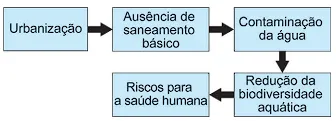
In this context, how is urbanization causing risks to human health?
Spreading parasitic diseases.
Causing eutrophication of lagoons.
Increasing the chance of contact with coliform bacteria.
Reducing the population of aquatic predators.
Bringing people closer to areas where mosquitoes are present.
Explicación Oficial / Explicaciones de la Comunidad
Analysis of the Relationship between Urbanization and Health
The correct answer is option A. D) Decreasing the population of aquatic predators.
1. Interpreting the Flowchart
The question asks you to explain how urbanization poses risks to human health. within the context presented by the flowchartTherefore, we must follow the chain of cause and effect shown:
- Urbanization → Lack of basic sanitation: The uncontrolled growth of cities often leads to a lack of adequate infrastructure. 2. Lack of sanitation → Water contamination: Domestic sewage and other pollutants are dumped into rivers, lakes, and streams without treatment. 3. Water contamination → Reduction of aquatic biodiversity: Water pollution makes the environment inhospitable for many forms of life. More sensitive organisms die, reducing the variety of species. 4. Reduction of aquatic biodiversity → Risks to human health: This is the final link we need to understand in the context of mosquito-borne diseases.
2. Connecting Biodiversity to Mosquitoes
The introductory text focuses on mosquito-borne diseases (arboviruses). The mosquito's life cycle, such as the Aedes aegypti, includes an aquatic larval stage.
- What does "reduction of aquatic biodiversity" mean in this scenario? It means the death of fish, amphibians (tadpoles), and other insects (such as dragonfly larvae) that live in the water. * What is the ecological role of many of these animals? They are natural predators of mosquito larvae.
Therefore, the logic of the flowchart, when applied to the mosquito problem, is as follows: water contamination eliminates aquatic predators. Without their natural enemies, mosquito larvae proliferate uncontrollably, leading to an increase in the adult mosquito population and, consequently, a greater risk of transmission of diseases such as Zika and Chikungunya.
3. Evaluation of Other Alternatives
- A) Spreading parasitic diseases: Although lack of sanitation can cause parasitic infections, this risk pathway does not include the "reduction of aquatic biodiversity" stage, which is a mandatory step in the flowchart. * B) Causing eutrophication of lagoons: Eutrophication is a type of water contamination and a cause biodiversity loss is a contributing factor, but it is not the final link to health risks, as shown in the diagram. * C) Increasing the chance of contact with coliforms: Like parasitic infections, this is a direct risk of "water contamination," but it ignores the subsequent step of "reduction of aquatic biodiversity" shown in the flowchart. * E) Bringing people closer to areas where mosquitoes are present: Urbanization can do this, but it is not the specific cause of risk described by the flowchart's chain of events, which focuses on the ecological consequences of water pollution.
4. Conclusion
Following the logic presented, urbanization leads to water contamination, which in turn causes a decrease in the population of aquatic predators (a form of biodiversity reduction). This lack of natural population control allows mosquitoes to proliferate, increasing risks to human health.