
Pregunta de Natural Sciences and their Technologies #019e354b
For open water swimming circuits held in calm seas near the beach, a system of buoys is set up to determine the path to be followed by the swimmers. One of the difficulties of this type of circuit is compensating for the effects of the ocean current. The diagram shows the circuit in which one lap must be completed in a counter-clockwise direction. The four buoys are numbered from 1 to 4. There is an ocean current with a speed of υc →, whose magnitude is 30 meters per minute, parallel to the beach throughout the circuit area. On the longer edges, the swimmer will need to swim in the direction indicated by the vectors υn → from points 1 to 2 and from 3 to 4. Consider that the swimmer's speed is 50 meters per minute, relative to the water, throughout the circuit.
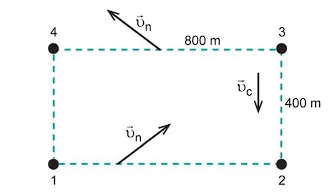
In this situation, in how many minutes will the swimmer complete the race?
42
65
72
105
120
Explicación Oficial / Explicaciones de la Comunidad
Analysis of the Open Water Marathon Race Time
The correct answer is option A. B) 65.
1. Resolution Strategy
To find the total race time, we need to calculate the time spent on each of the four sections of the course and then add them together. The calculation of the time in each section (t = distance / speedThis will depend on the swimmer's effective speed relative to the ground, which is the vector sum of their swimming speed and the speed of the current.
Data: * Swimmer's speed relative to the water (|vₙ|): 50 m/min * Current velocity relative to the ground (|v꜀|): 30 m/min * Distances: 800 m (long stretches) and 400 m (short stretches)
2. Section 2 → 3 (Against the Current)
- Distance: 400 m. * Analysis: The swimmer is moving upwards, while the current is pointing downwards. He is swimming directly against the current. * Effective Speed: Effective speed is the result of subtracting the speeds. * vₑ = |vₙ| - |v꜀| = 50 - 30 = 20 m/min * Time (t₂₃): * t₂₃ = 400 m / 20 m/min = 20 minutes
3. Section 4 → 1 (With the Current)
- Distance: 400 m. * Analysis: The swimmer moves downwards, in the same direction and sense as the current. * Effective Speed: Effective speed is the sum of the speeds. * vₑ = |vₙ| + |v꜀| = 50 + 30 = 80 m/min * Time (t₄₁): * t₄₁ = 400 m / 80 m/min = 5 minutes
4. Segments 1 → 2 and 3 → 4 (Perpendicular to the Current)
- Distance: 800 m (for each section). * Analysis: In these sections, the swimmer wants to move horizontally, but the current pushes him vertically downwards. To compensate and follow a straight line, he needs to steer his swimming (vₙ) slightly upwards. The effective velocity (vₑ) will be the horizontal component of the movement. The velocities form a right triangle: * The hypotenuse is the swimming speed: |vₙ| = 50 m/min. * One leg of the equation is the current velocity: |v꜀| = 30 m/min. * The other leg is the actual speed along the path: vₑ. * Effective Velocity (vₑ): We use the Pythagorean Theorem. * |vₙ|² = vₑ² + |v꜀|² * 50² = vₑ² + 30² * 2500 = vₑ² + 900 * vₑ² = 2500 - 900 = 1600 * vₑ = √1600 = 40 m/min * Time (t₁₂ and t₃₄): The time for each of the 800 m segments will be: * t₁₂ = 800 m / 40 m/min = 20 minutes * t₃₄ = 800 m / 40 m/min = 20 minutes
5. Calculation of Total Time
Now, we add up the times of all the segments:
- Total Time = t₁₂ + t₂₃ + t₃₄ + t₄₁ * Total Time = 20 + 20 + 20 + 5 * Total Time = 65 minutes